

US Digital Advertising Market Growth Aims for Stable Growth in 2026
December 9, 2025
While brands obsess over acquiring more transactional data and perfecting their CRM strategies, they’re sitting on a treasure trove of insights that most treat as mere operational exhaust: their campaign impression logs.
Every programmatic campaign generates billions of data points that reveal not just who saw your ads, but the intricate patterns of how your best customers actually behave across the digital ecosystem. Yet according to recent industry research, less than 15% of advertisers systematically analyze their impression data for audience intelligence beyond basic frequency capping and attribution windows.
This represents one of the largest missed opportunities in modern advertising.
The Base Layer’s Hidden Intelligence
As we outlined in our data pyramid framework, campaign impression and web pixel data form the foundation, the widest, most scalable tier of first-party data. What makes this base layer so valuable isn’t the individual impression (which, admittedly, is a weak signal), but the aggregate behavioral patterns that emerge from analyzing millions of touchpoints.
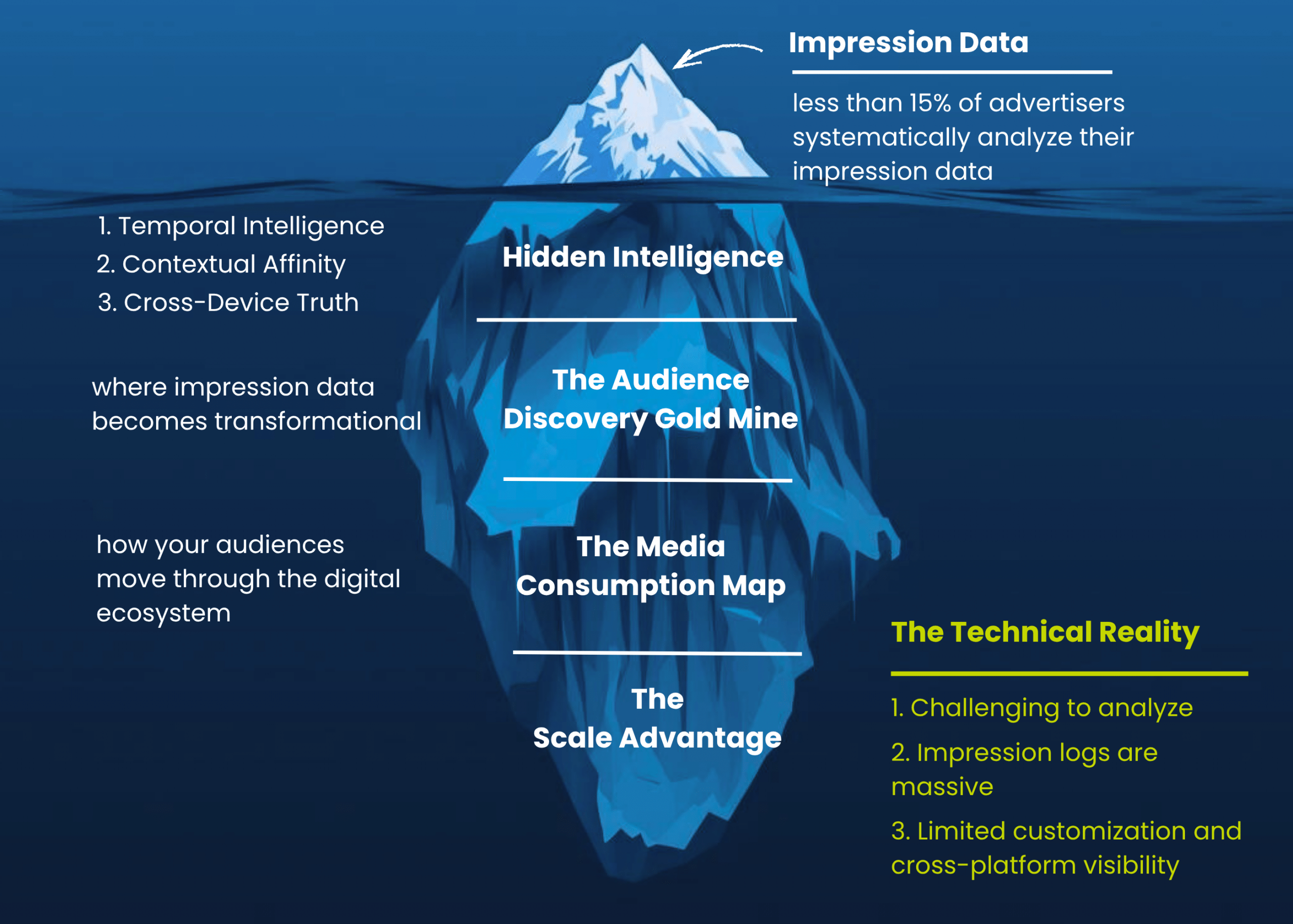
Consider what your impression logs actually contain:
- Temporal Intelligence: When do your highest-value segments consume media? Most advertisers know their customers convert on weekends, but impression data reveals they research on Tuesday evenings, compare options Wednesday through Friday, and make purchase decisions Sunday morning. This isn’t just scheduling data, it’s a roadmap to the customer journey.
- Contextual Affinity: Your impression logs don’t just show where your ads appeared; they reveal where your best customers spend their digital time before they ever visit your site. That financial services lookalike audience? They’re not just reading WSJ and Bloomberg, they’re consuming true crime podcasts, following specific YouTube channels about personal finance, and spending significant time on real estate platforms.
- Cross-Device Truth: While platforms provide their own cross-device matching, your impression logs contain the raw behavioral signals that reveal actual device usage patterns. You might discover that your “mobile-first” audience actually researches extensively on desktop during work hours, then converts on mobile during commute windows.
The Audience Discovery Goldmine
Here’s where impression data becomes transformational: it reveals audiences you never knew existed.
A major automotive brand recently analyzed 18 months of impression logs and discovered their highest-converting segment wasn’t traditional car enthusiasts, but parents of teen athletes who lived in suburban areas with specific income and commute patterns. These parents exhibited predictable digital behavior; they consumed local news sites, spent significant time on school district websites, and showed elevated engagement with content about safety and reliability rather than performance specs.
This insight didn’t come from surveys or focus groups. It emerged from pattern recognition across 2.3 billion impression events.
Traditional audience segmentation asks: “Who are our customers?” Impression log analysis asks: “What do our customers do, and where do they go before they become customers?” The latter question unlocks expansion opportunities that no amount of transactional data can reveal.
The Media Consumption Map
Your impression logs contain a detailed map of your customers’ media consumption habits, data that’s impossible to obtain any other way. While platforms guard their inventory insights jealously, your impression logs reveal exactly how your audiences move through the digital ecosystem.
Smart advertisers are using this intelligence for competitive analysis. If your best customers consistently engage with content on specific publisher networks, what other brands are successfully reaching them there? More importantly, what content formats, messaging themes, and creative approaches resonate in those environments?
This goes beyond simple competitive intelligence. One consumer electronics brand used impression log analysis to identify that their highest-value customers exhibited strong engagement patterns on B2B-focused technology sites, despite being consumer purchasers. This insight led them to adjust their messaging strategy to emphasize professional use cases and productivity benefits, resulting in a 23% improvement in conversion rates.
The Scale Advantage
The most compelling aspect of impression data is its sheer volume. While your transactional data might include thousands or tens of thousands of customers, your impression logs contain behavioral signals from millions of individuals, including the 95%+ who haven’t converted yet.
This scale enables sophisticated statistical analysis that simply isn’t possible with smaller datasets. You can identify micro-segments, test behavioral hypotheses, and validate audience expansion strategies with statistical confidence.
More importantly, impression data is refreshed constantly. While transactional data provides historical truth, impression data provides real-time behavioral intelligence. Market shifts, seasonal changes, and competitive pressure all manifest first in impression-level engagement patterns, often weeks before they appear in conversion data.
The Technical Reality
Of course, there’s a significant barrier to accessing these insights: impression logs are massive, messy, and technically challenging to analyze. A single month of programmatic activity for a mid-size brand can generate terabytes of impression-level data across dozens of platforms, each with different data schemas and identifier systems.
Most brands either ignore this data entirely or rely on platform-provided reports that offer limited customization and cross-platform visibility. The few advertisers who attempt in-house analysis often struggle with data engineering complexity, storage costs, and the statistical expertise required to extract meaningful patterns from such large datasets.
This technical barrier is precisely why impression data remains undervalued. The brands and agencies that solve the analysis challenge gain significant competitive advantages precisely because their competitors haven’t made the investment.
The Strategic Imperative
As the digital advertising ecosystem evolves toward privacy-first measurement and reduced reliance on third-party data, impression logs become increasingly strategic. They represent the largest pool of first-party behavioral data most advertisers possess, data that’s entirely owned, completely privacy-compliant, and rich with insights about customer behavior.
The question isn’t whether this data is valuable. The question is whether you have the infrastructure and expertise to extract that value systematically.
In our next post, we’ll explore the specific pain points that prevent most advertisers from capitalizing on their impression data and why solving these challenges is becoming a competitive necessity rather than a nice-to-have capability.